
Relocating to the Principality of Monaco is a major financial and personal milestone. Securing your official residency card requires strict preparation. The application process is highly regulated, and the government carefully reviews every single candidate in 2026.
The exact steps you must follow depend entirely on your nationality. European citizens enjoy a relatively straightforward path. However, Non-EU citizens from the United States, the United Kingdom, and the Middle East face a different set of legal requirements.
If you hold a Non-EU passport, you must secure a specific long-stay visa from France before you can even begin your Monaco application. American buyers can review these exact visa steps in our dedicated US Citizens Residency Guide.
We created this complete 2026 Monaco Residency Checklist to simplify your relocation. Whether you are an EU national or a foreign investor, this guide breaks down everything you need to know. You will discover the exact private bank deposit rules, the mandatory housing requirements, and the step-by-step legal process for a successful application.
Before you dive into the paperwork, we also recommend reviewing the real Cost of Living in Monte Carlo to accurately plan your transition budget.
This guide is part of our complete Monaco Residency Requirements 2026 resource.
How to obtain Monaco residency as a Non-EU citizen?
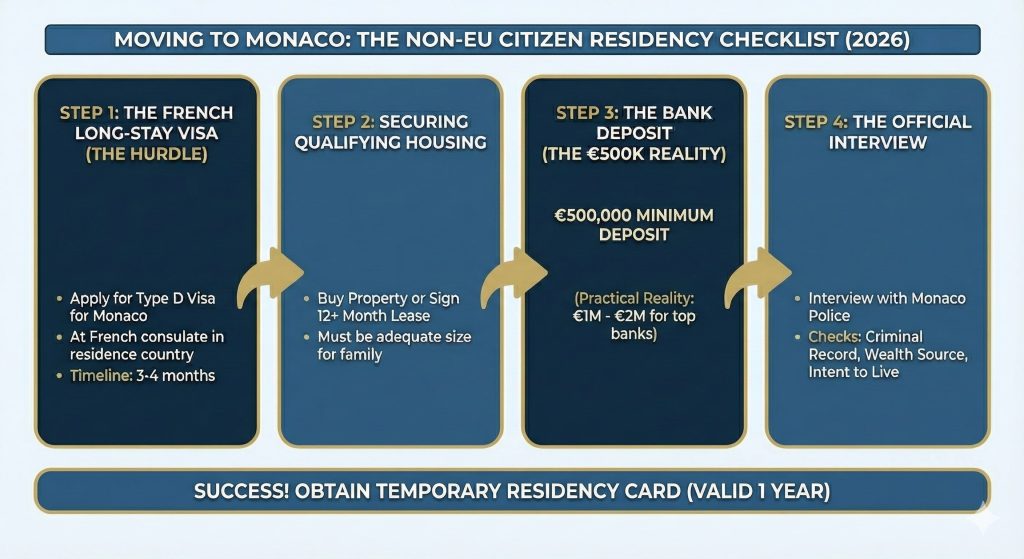
The Short Answer: To become a resident of Monaco in 2026 as a non-EU citizen, you must complete four main steps. First, obtain a Type D Long-Stay Visa from the French consulate in your current country. Second, secure a qualifying property in Monaco (rental or purchase). Third, deposit a minimum of €500,000 into a Monaco bank to prove financial self-sufficiency. Finally, pass the official residency interview with the Sûreté Publique.
Here’s the more detailed step-by-step guide.
Step 1: The French Long-Stay Visa
This is the step most people overlook. Because Monaco does not have its own border control (it relies on France), you cannot just fly to Nice and apply for residency.
Non-EU citizens must first apply for a Type D Visa for Monaco at the French embassy or consulate in their country of residence.
- What to ask for: A “Visa de long séjour valant titre de séjour” marked for Monaco.
- Timeline: This process can take 3 to 4 months. Do not cancel your current lease until this is approved.
- Exceptions: If you have already lived in France for more than one year, you may be able to transfer your residency directly without returning home.
Step 2: Securing Qualifying Housing
You cannot apply for a visa without a place to live. You must prove you have accommodation in Monaco that is large enough for your family size.
You have three options:
- Buy a Property: You must hold the title deed. (See our guide on the Benefits of Buying Property in Monaco).
- Rent an Apartment: You must sign a lease for a minimum of 12 months.
- Corporate Ownership: You can live in a property owned by a company, provided you are the beneficial owner.
Expert Note: The “Bedroom Rule” is strict. If you are a couple with two children, a one-bedroom apartment will be rejected. You need appropriate square footage. For families, we recommend looking at the Larvotto Neighborhood for space, or Moneghetti for value.
Step 3: The Bank Deposit (The €500k Reality)
To prove you will not be a burden on the state, you must open a bank account in Monaco and deposit a minimum sum.
- The Official Minimum: €500,000.
- The Practical Reality: While €500k is the legal floor, many top-tier private banks in Monte Carlo now require €1 million to €2 million to open a relationship with non-residents.
- The Letter: The bank will issue a “Attestation Bancaire” confirming you have the funds. You need this specific document for your residency application.
Step 4: The Official Interview
Once you arrive in Monaco with your visa and housing contract, you will apply for the Carte de Résidente at the Sûreté Publique (Police). You will be summoned for an interview.
What they check:
- Criminal History: You must provide a clean police record from the last 5 years of residency.
- Professional Background: They verify the source of your wealth.
- Intent: They want to ensure you actually plan to live in Monaco (minimum 3 months a year for the first card).
Need Help Navigating the Process?
Free Introduction to Trusted Specialists
Moving to Monaco requires coordination between immigration lawyers, bankers, and real estate agents. One mistake in the paperwork can delay your move by six months.
We do not sell services, but we know the people who do. We can introduce you to verified English-speaking experts who handle:
- Visa & Residency Applications
- Bank Account Opening (with known deposit limits)
- School Admissions
Here’s the visualized checklist
Frequently Asked Questions
What are the main requirements for Monaco residency in 2026?
Every applicant must satisfy three core conditions: suitable accommodation in Monaco through a purchase or a registered lease of at least twelve months, proof of financial self-sufficiency (typically a bank deposit of at least €500,000), and a clean criminal record. Non-EU nationals must also obtain a French long-stay visa (Type D) before applying.
How much money do you need to get Monaco residency?
The standard practice among Monaco banks in 2026 is a minimum deposit of around €500,000 to open a residency banking relationship, and many banks require more, particularly for non-EU applicants. The bank then issues a formal attestation for your application. The deposit remains your own money, held in your Monaco account.
Do non-EU citizens need a visa for Monaco residency?
Yes. Non-EU nationals, including Americans, Australians, and post-Brexit British citizens, must first obtain a French long-stay visa (Type D) from the French consulate in their home country before they can apply to the Monaco authorities. EU and EEA citizens skip this step and apply directly to the Section de Résidents.
What documents do I need for a Monaco residency application?
You typically need a valid passport, proof of accommodation (title deed or registered lease), a bank attestation confirming your deposit, a criminal record certificate from the countries where you have recently lived, proof of health insurance, and completed application forms. Non-EU applicants must also include the French Type D visa. Exact requirements vary by nationality.
How long does the Monaco residency process take in 2026?
For EU and EEA citizens, the process generally takes two to four months once accommodation, banking, and documents are in place. For non-EU citizens, it takes longer, often four to eight months, because the French Type D visa must be obtained first, which alone can take three to four months.
Can you rent instead of buying property for Monaco residency?
Yes. You can satisfy the accommodation requirement with a registered rental lease of at least twelve months in your name, rather than buying. The accommodation must be genuine and large enough for your household. A hotel address or short-term rental will not be accepted. Many applicants rent first and buy later.
Does Monaco have a golden visa or residency by investment?
No. Monaco does not operate a golden visa, an investment visa, or a points-based route. Residency is access-by-means: the substantial bank deposit and the cost of accommodation mean only financially self-sufficient individuals qualify, but there is no formal program where a fixed investment automatically grants a permit.
What is the bank attestation for Monaco residency?
The bank attestation (Attestation Bancaire) is a formal letter your Monaco bank issues confirming you hold the required deposit. It is addressed to the Immigration Section of the Sûreté Publique and is one of the central documents proving your financial self-sufficiency. You obtain it after opening a Monaco account and placing your funds.
Do Monaco residents pay income tax?
No. Monaco levies no personal income tax on its residents, with the exception of French nationals under a bilateral treaty. There is also no capital gains tax or wealth tax. Holding the residence card does not automatically end your tax obligations elsewhere, so genuine relocation matters. See our Monaco Tax Calendar 2026.
How often do I need to renew my Monaco residence card?
The first card is valid for one year and renewable. After three years of residence you become eligible for a three-year card, and after ten years a ten-year privileged card. Each renewal requires proof that you continue to genuinely live in Monaco, including an updated bank attestation and proof of accommodation.